Wisdom from our Robotics Event
Recapping the Jan 24 Panel Event

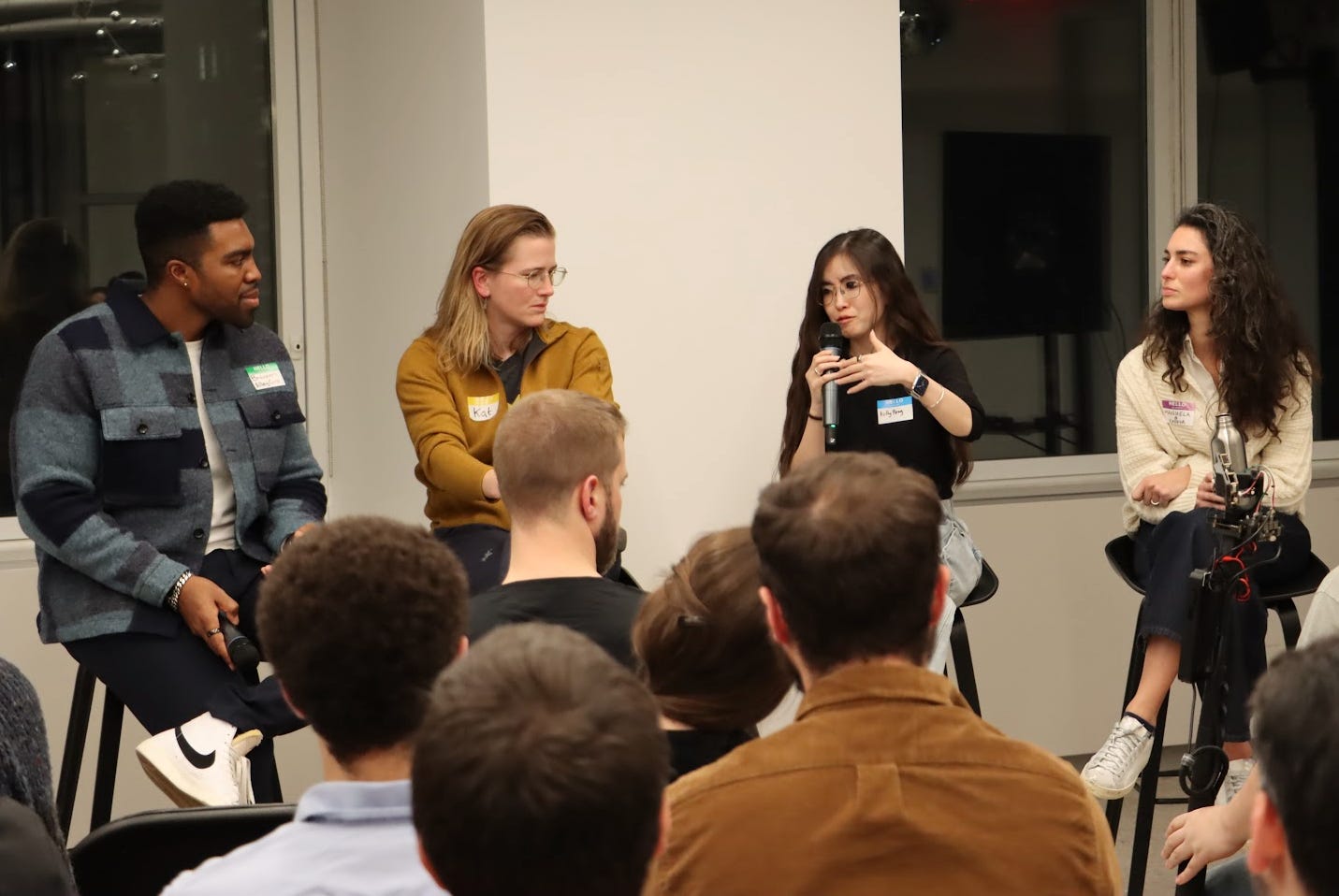
On January 24th, we co-hosted an event with Viam at their headquarters here in NYC. The NYC robotics ecosystem came together (along with visitors from around the country) to eat, drink, network, and theorize about the sector. The event was oversubscribed and the room was packed with nearly 200 attendees. Amidst the din of conversation was an audible whir of robot prototypes walking, crawling, rolling, swimming, and even doing back flips throughout the venue. The main event of the evening featured a panel with 3 of the most impressive early stage robotics CEOs in the country:
Kathryn Zealand, Founder & CEO, Skip
Kelly Peng, Founder & CEO, Kura Technologies
Manuela Zoninsein, Founder & CEO, Kadeya
These founders are running some of the fastest growing and most ambitious companies in the industry. Through their answers, we were given a first hand glimpse into how these leaders are successfully navigating the challenges of the sector. For anyone who missed the event on the 24th, we’ve included my conversation with the panelists and their insights below (lightly edited for clarity and brevity).
Kathryn Zealand, Founder & CEO, Skip
What is Skip Robotics’s mission and how are you designing your go-to-market strategy to meet the needs of your customers?
We're trying to help people get active and stay active, particularly as movement starts to get more difficult with the aches and pains and pounds that tend to accumulate over the years. To me, that's really important. I was really close with my grandmother and she used to walk everywhere - she'd walk to church, she'd walk to the shops, she’d walk to bridge club. But as she started to struggle with that one-mile walk from her home into town, her whole social life became a lot smaller. Until I saw that personally, I hadn't fully appreciated how physical mobility is such a key to living a full life. So that's what we're trying to do here at Skip. We are trying to restore people's ability to move, but it’s really all in the name of enabling them to be more happy, active, healthy members of their communities. We want to build a world where nobody feels left behind.
Now about our market - I think we all know that many people struggle with movement. Movement is hard! What's not obvious is the best way to go about solving that fact. And exoskeletons in particular have sucked for a very long time. We've had decades of designs that were funded by the military, so they've been high-power, bulky suits that men in their 20s wear while loading missiles into tanks. My granny ain’t going to wear that! So we asked ourselves, “What are the biggest risks that we need to understand to actually build something useful for a large majority of the population?” One of those big risks was in understanding what people will actually wear. Like, “What will people be excited about putting on their body and wearing all day rather than being a ‘necessary evil’? How can we make something that fades into the background so you can focus on doing the things you really care about as you move about your day? How can we make it look a little bit, if not sexy, more functional?” These questions are often not the same physical robotics challenges that most hardware companies struggle with.
We get a lot of our inspiration from e-bikes. The advertisements for e-bikes all show people in their 30s climbing mountains, but actually the median purchaser of an e-bike in America is over 65 years old and is often using it to get out of the house a bit more. So we look at that example and ask ourselves, “What would that look like for exoskeletons?” So that's what Skip is starting with - a recreation device, where we're not making any medical claims, but we're giving you a major “boost” while solving all of the wearability problems. We're trying to look at what people will wear and love and come back to day after day. I'm wearing a mock-up example today that you probably didn't even notice, and something of this size and shape can provide up to 40% assistance to someone. The wearer still initiates the movement, but the device helps make stairs and hills and the various other “speed bumps” in your daily life way less of a barrier. Skip is on a mission to restore the joy of movement with the most useful, comfortable, easy-to-use, good-looking, powered wearable that fits seamlessly into daily life.
In 2023, we saw VC funding pull back significantly. Total capital deployed was down nearly 40% and the robotics sector wasn't spared. How do you think about navigating today’s environment relative to the low interest rate environments that came before?
I think every company is different. Before we spun out of Google X, X had four public robotics projects. First, they had us, and we were essentially at the seed stage. We spun out and raised money, and I think that's actually pretty typical. The seed stage is still really active; VCs have to deploy capital, and the cheques are small enough and timeline long enough that the current crunch hasn’t impacted much. You've got to have sharp messaging about what your go-to-market is going to be but it’s possible.
There was another team that was streamlining the process of programming robots and they did well because they save money for their customers. So if anything, their business improved when the rest of the economy tightened, and so they were able to make a very clear case to fundraise and scale. No problem.
The third was Everyday Robots is one of the ones which hasn't survived in the same way. They were deploying AI on robot arms and trying to solve some of the fundamental problems in robotics that everyone had a lot of time for when it was easy to get money and no one was worried about cost cutting. But when people started saying, “Okay we're going to pull back a little bit and we're going to be more selective’, EDR was the hardest one to justify continuing to invest in - as opposed to the projects that were solving current problems, or all the projects that were so early stage that they didn't need much money to de-risk whether we could solve the problem. So they ended up kind of winding down a lot of their hardware efforts.
The final project was in agricultural robotics. It’s a huge industry with clear market potential, but also fast-moving competition and significant capital required to scale. So they suddenly have to answer “How are you going to win?” “Why is it gonna be you?” “How much more capital will you need until you’re profitable?”. They've really got to execute to perfection so I think like many robotics projects they felt the changing winds of the high-interest rate environment the most.
So that's just a bit of a snapshot, that reflects a company’s stage and market position really affects how they’re weathering the current environment.
So your team spun out of Google X. How have you as a leader helped them to shift their mindsets from a research environment to commercialization as the goal?
Google X was great at convening and assembling talent; only a couple of my team had come from Google, most I’d recruited directly from top companies, labs and clinics. Mission driven people who are passionate about actually solving the problem, and had often already spent years of their life working with patients. That meant that they wanted to get a product out the door, and if anything Google was much slower moving than we wanted. The spinout was also a great forcing mechanism for team members to really think about what they wanted, and only those excited about start-up life opted-in to Skip.
One of the big mindset shifts was going from the investigative X mindset of “what experiments can we do to help decide if Google should invest in this project?” to a more focused attitude of a start-up that is building the solution. For me as a leader, it helped to be be really transparent around, “Okay guys, we have this much runway. Here's what we need to deliver, and if we don't deliver that, it’s an existential crisis to the business and that will affect your job as well”. I never want to stress people out, but I actually think having that level of openness and honesty makes it not solely my job as a CEO and my stress only. The team has to hit these milestones.
How do you navigate the operational risks of managing your supply chain - especially while building a consumer facing hardware business?
There were some rough times a couple years ago where people were hoarding chip sets, and they wouldn't give them to anyone unless you paid an exorbitant amount. There were a bunch of really scrappy things that we did during the year because we could not buy chips for the price we wanted, or at all in some cases. Luckily for us that is better now. So we are now able to source components. It does make us think differently about the long term ramifications, especially as trade relations with China evolve, so that's on our minds.
There are some components that we source overseas, because it's just so much cheaper, and they're fairly standard. All of our PCBs are actually turned around faster by our Chinese vendor, than by our local one, despite having to get it shipped across the world. For other components we've faced quality control issues, or need a lot of back and forth. I’m worried that we’d need someone on the vendor’s factory floor, while that's being made, and that might become more difficult over time.
We haven't committed yet to where we're going to do assembly for our first commercial run, and we're looking at Asia, we're looking at Mexico, and then we're also looking locally in California - which sounds crazy from a cost perspective. But our goal right now is not to make money today, it's to show how this will be a unicorn in the future. If we produce locally, it's going to be more expensive, we might be making a loss to every individual unit, but if we're only making a couple of thousand in the first run, we'll be able to make sure the quality is there, understand the supply chain, change components last minute if we need to, and then it's easy enough to convince investors that we could lower that cost base as needed later… It's sort of an interesting flip, whereas five years ago we wouldn't have even considered doing this locally. So it's definitely top of mind, but every supply chain is different, and every company is different.
Last question: Let’s imagine we are one year in the future and we're talking about how 2024 was the catalyst year for robotics - what happened to make us say that?
When you ask that question, I think about when smartphones became common and we stopped being like, “Oh my god, what is that?” when you saw one. I'd love to see that for robotics. That means a lot of the population, maybe a third, have an interaction once a week with a robot, and they're not going, “oh weird, that's a robot making coffee”. You just have a normal interaction and it might be at your own workplace, or when you visit an older relative who has a robot at home, or it might be that you're in hospital and there's a robot there. But you're not thinking, “Wow, that's a really novel robot transaction!” because there are a lot of people who are interacting with them in their daily lives and in a way that's useful without being novel.
Kelly Peng, Founder & CEO, Kura Technologies
Telepresence technology has been around since the 90s. What's different about your technology and your approach?
So we're building a next generation, revolutionary telepresence platform that includes both hardware and software. So first, we build our robots and one example that we’ve built is a biped with two legs with wheels. We gave it larger wheels so it can handle more difficult terrain than an indoor telepresence robot that only rolls. The newer generation we are building will be able to handle going up and down stairs, and to me that was one of the biggest issues with telepresence robots, they could only handle extremely flat floors. Like if there was a wire there, or carpet, or a staircase, its movement would be very restricted. We have one that can handle the outdoors, even parks, rocks, or more abstract land. So our edge is a combination of different robots.
Then we build our own perception stacks and planning. We have a partnership with Zoom so people can use Zoom's global infrastructure for streaming telepresence, and anyone with a Zoom account will be able to use Zoom to go to different places. We're working with a lot of large enterprises for factory tours for remote workers.
Another side is we're building a global software platform besides just the hardware. You'll be able to do telepresence through AR glasses, through VR glasses, through the phone, or through Zoom, and so you don't need to own the robot anymore. If you don't need to own the robot, you don't need to maintain the robot. So that's another area we are working on.
How have you navigated attracting robotics talent in this AI hype cycle where deep specialists likely have many other options on the job market?
Yeah - building the team is important for us. We're lucky that we had a really good starting team from MIT who’ve been working on hardware products for many years in the past. I have an example. We just hired a contract PhD who had been working on controls for flying cars and also had been doing controls at Waymo before starting working with us. When he was choosing which startup job to take he said “I want to join a team that is very strong in electronics, mechanical, and can be very hands-on building a lot of new projects. So, are you guys very good at motor control specifically?” and I'm like, “Yeah. My co -founder Bailey, was controlling motors 10 years before he even learned how to write Python.”
The rest of our team is made up of people who are very good at electronics, EE, high frequency tracings, motor controls, and power electronics - all those fields. Once you get top notch people in one field on your project, then even if you need more people in different areas of application development, it's easy to get more people of the same caliber. We also do a lot of hiring through networks. About half of our founding team is from MIT or was MIT based so it's a good network and once you have a few of these folks you get more and more.
We also always have a list of roles describing who we were looking for, like program managers, mechanical engineers, software engineers, algorithm engineers and so on. We post jobs, we ask our advisors, we ask current employees to look through their networks, and sometimes we just happen to meet a person who is really amazing and we try to hire that person really quickly because otherwise we might never catch them again.
What role will AI play in the future of robotics? Is it going to be critical? A nice to have? Or just a distraction?
So AI definitely has helped robotics a lot. First, it's been a big thing in self-driving. The self -driving tech stacks have become a lot more mature in the past several years, especially for telepresence in robots since you don't need to get on a busy road, like driving a car so it's less dangerous. Basically our entire perception and algorithm team members are coming from the background of building self driving tech, either for robots or for cars. A lot of the tech stack they had built for the infrastructure layer there is really helpful here for telepresence robots. It's almost immediately usable and we can just build on top of that with basic tuning for our application. So that is really, really helpful.
Another upcoming area where I receive a lot of requests, is from people proposing AI wearables. Like a necklace or headband that’s recording personal data, acting as a personal assistant, and answering questions. At the same time, you're also helping train data for robots doing tele-ops and telepresence. So it learns how people react to conversations, it can see how people pick up different things. It can be used in warehouses to train more warehouse robots, or can be used while people cook. So that is another area I see: using AI to aggregate even more data. There are a lot of engineers who are extremely passionate about that. So I think AI will actually really help accelerate robotics in the upcoming years, just as with self-driving cars.
Should a founder starting a robotics company today base their solution on generative AI?
So my personal answer is not necessarily. If your solution for customers is solving an immediate market problem, and your go -to -market does not include a path for generative AI, you should not include it. If I tried to do generative AI for robotics right now and instead of using general perception and reinforcement learning, we tried to use generative AI - what would we even generate?
Some of the generative AI in the next couple of years will help robotics. For example, you could do a lot of 2D to 3D generation, and you can generate a training environment. You can simulate different terrains with ease. One thing we've been using it for is when we need to create 3,000 different voices to train our robot to respond to “Hey Kura”. So we use generative AI to train with many different sounds. That's one way generative AI helps us, but you don't have to force it unless it's meeting your goal.
Last question: Let’s imagine we are one year in the future and we're talking about how 2024 was the catalyst year for robotics - what happened to make us say that?
After Kura’s launch people will be able to go to different places in the world much more easily without having to get on a flight, get a visa, or worry about Covid -19. They will be able to stay in their bedrooms, or stay in the office and they can go to see a factory, meet their suppliers, and have a city view of Tokyo. I think that will make their post-work life much easier and more enjoyable.
Manuela Zoninsein, Founder & CEO, Kadeya
Tell us a little bit about Kadeya, and in particular, how do you position your product to customers in old school industries given your sustainability focus?
So Kadeya is my third business and the past 15 years of my life have been spent in sustainability, and the main lesson I've learned is that sustainability does not sell as a standalone value proposition. If sustainability is going to succeed, it has to first of all be accessible and scalable and it has to be able to compete against the status quo alternative - against what I call CCQ: cost, convenience, and quality. Then you get to talk about sustainability and a bunch of other nice-to-haves.
Kadeya started with me just hating single use packaging in general, and I narrowed in on bottles of water. Which I think actually unite most of America in our hatred of them - it doesn't matter your age, your geography, political leaning, everybody realizes that it's ridiculous and it has become this kind of necessary evil, so to speak. As I started thinking about that, I was living here in New York, working at Palantir and I looked to Citi Bike. I thought, well, could we do bike sharing for bottles? It's kind of a similar use case, right? You don't need that bike all day. You need it once or twice, maybe a couple times a day to get a job done, and then you're gonna park it. Similarly with hydration, you need the container to consume what's inside, but the container's just a means to an end and you only need it for that time that you're trying to get hydrated.
I started telling that to people and they said, well, that's crazy and I said, “Okay, well, what's crazy about it?” And first was “How are you gonna get the bottle back?” And so I thought, “Okay, let's figure that one out,” and I found that if I put serialized numbers on bottles and then asked customers to write their name, email, or phone number before getting the bottle, 99% of the time I got the bottle back with no penalty or deposit — and we're still seeing that today. The other question was, “How are you gonna wash the bottles and get people to trust you?” So we invested in building what Ecolab has said is the world's best bottle wash and sanitizing system.
Then the third big problem is what Brannon’s question alluded to. I knew white collar environments and I knew academic institutions but then Covid hit and those were no longer places where I could pilot. So I thought, “Well, where are people going?” I was lucky enough to move back to Chicago where I went to high school and I was taking a sailing lesson on Lake Michigan and a woman in my boat happened to work in construction at a major construction firm. She said, “I can't get you into an office but I can get you on the work site tomorrow.” That was the “aha” I needed. So I spent about six months doing customer discovery interviews on the job site while we developed the wash and sanitize system and I discovered a resounding need in construction, manufacturing plants, fulfillment centers, and military that I had not heard of in other environments.
Now what's common about all these environments, in addition to the fact that humans are showing up to work, is that the population requires hydration to perform their job, and the logistics of getting hydration solutions to the workforce are actually very time intensive and costly. So we found out that the pain that we're solving is real. As an example, I was at the country's largest health care construction site in downtown Indianapolis, and the project executive asked to buy our alpha prototype before I even plugged it in. I said, “Why do you want to buy this? You don't even know if it works.” And he said, “What am I gonna do if Kadeya leaves? Go back to buying and distributing single use plastic water bottles.” The insight was that single use is an expensive, inefficient, labor-intensive logistics problem that Kadeya can solve, and that of course lends itself to reducing costs. We've really been focused on being at parity with single use bottles and we’ve achieved that. Now the main focus that we're trying to smooth out is the user experience so we can deliver that CCQ, (the cost, convenience, and quality) of single use. Now we can talk about sustainability, but we had to earn our right to be able to start talking about sustainability.
How do you lead your team in thinking about DEI and how does Kadeya represent that?
This question is really strategic for the business because for sustainability to scale it has to be accessible. What we're building at Kadeya can be the global solution for hydration for all of humanity. The ability to solve in its entirety the single use plastics pollution problem, at least in one sector, is a key motivator for me and a design constraint on the company writ large. Let me briefly mention what we actually do. We've got a machine, it's the size of a vending machine, and like a vending machine we have all types of beverages conveniently available: Coke, Pepsi, Cold Brew, Ice Tea, Water, branded, white label, global or local - we can currently do all cold beverages from a concentrate. We’ll get to hot beverages later. Unlike a vending machine, however. you have to return our bottle (which we own) to any station in the network. So, it's like Citi Bike, for bottles. Then our patented unit washes, sanitizes, inspects, and refills the bottle inside of itself, meaning every bottle is a third of the cost of a single use product that you currently purchase and the carbon footprint is 75% less per bottle, with 99.999% less plastics waste.
Then with building the team, part of what I'm looking for is a global world view and a point of view on how our solution can not only satisfy our beachhead market, but can also continue to expand to other markets. I'm from Brazil originally, and I’ve lived in China, so I think about both of those markets a lot. My CTO is from India. We have someone from Mexico on the team, we have someone from France on the team. So, we're really trying to think about Kadeya from day one in both a really narrow sense and in a really broad sense too. I think about DEI as making sure that we've got a comprehensive geographic, and also a socio-economic, representation of our end users, who are, we believe, ultimately the entire world.
The serendipitous beauty of Kadeya’s go to market strategy is that manual labor is itself comprised of a very diverse (and I’ll add, generally under-served) population, which means from Day 1 we are taking into account a broad diversity of consumer needs and preferences, all of which will position Kadeya to remain uniquely competitive and generate outsized value as we continue to scale.
How do you overcome scaling obstacles such as a lack of existing compatible infrastructure or public fears and misperceptions of robotics for example?
So again, we really do try to be as comparable to the status quo as possible, and then just do it better than what the status quo does. I think one of the challenges of sustainability and reusability is that we're asking consumers to change their behavior. I don't think that fundamentally works, unless your value proposition is so much better that someone is willing to learn how to do something differently every single day. So the user experience is designed to be familiar to a vending machine, but we’re actually faster than a vending machine. We're carrying known products and that was a very early strategic decision. A lot of other smart hydration solutions carry their own flavors, but I think that that's a mistake. I don't want to compete with Coke and Pepsi. I want to be their channel partner. I want them to be my customers and vice versa. So I'm carrying products people already know, love, and trust, and there's a nice brand halo from that.
At the end of the day, Kadeya is a hydration solution with very strong value delivery - the robotics are merely a means to that end. We don’t talk about ourselves as a robotics solution. And unlike a lot of other robotics companies, we’re focused on augmenting humans and helping them be more healthy, safe, and productive; we’re not trying to replace humans.
Last question: Let’s imagine we are one year in the future and we're talking about how 2024 was the catalyst year for robotics - what happened to make us say that?
I would say that robotics are what unlocked the circular economy and decentralized processing of materials at the point of use and then enabled the reuse of those materials. So I think it creates trust, it creates unit economics to make reuse competitive against single use, and then of course the story around reducing carbon footprint will have played out and as the world wakes up to the impending climate disaster. Kadeya will become the world’s clear winner as the most efficient channel for selling packaged beverages — without the packaging, of course.
Thanks to all who came out. It was great to get face time with members of our growing NYC community!
- Brannon Jones